
Lawn Problem Guide
Compacted Lawn Soil in Lancaster, PA: Signs and Solutions
Compaction reduces the pore space between soil particles. With less pore space, air and water move less freely and roots can have a harder time expanding — which often shows up above ground as thin turf, standing water and lawns that struggle during summer.
Start Here
What Compaction Actually Is
Healthy soil is not solid. A meaningful share of its volume is pore space that holds air and water and gives roots somewhere to grow. Pressure from foot traffic, mowers, vehicles and play compresses those pores, particularly when soil is wet.
Compaction can occur in many settings and varies by soil type, use and site history. It is not automatic in every lawn, but in established Lancaster County neighborhoods and in newer developments where soils were graded and worked during construction, it is a reasonable thing to check when turf underperforms.
Contributing Factors
What Leads to Compacted Lawn Soil
Compaction usually builds gradually from ordinary use rather than from one event.
Regular Foot Traffic
Walking routes, play areas and pet paths receive repeated pressure in the same lines, which is why thinning often follows the same shapes.
Mowing and Equipment
Mowing the same pattern each week concentrates weight along the same tracks, especially with heavier equipment.
Working Wet Soil
Soil compresses more readily when saturated. Traffic during wet periods generally has a greater effect than the same traffic on dry ground.
Construction and Grading
Heavy equipment and soil handling during construction can affect soil structure and topsoil depth in newer developments.
Fine-Textured Soils
Soils with higher clay content can be more susceptible to compaction than coarser soils under similar traffic.
Thin Turf Cover
Dense turf and its root system help maintain soil structure. As cover thins, the surface takes more direct impact.
Thin & Patchy Grass
Look Closer Before You Treat
Simple Checks for Compaction
These are homeowner-level observations, not laboratory measurements.
- Check 01
Does a screwdriver push into moist soil easily?
Strong resistance in soil that is already moist suggests density worth investigating further.
- Check 02
Does water pool or run off?
Water that sits on the surface or sheets away instead of infiltrating can indicate reduced pore space.
- Check 03
How deep do the roots go?
Cut and lift a small wedge of turf. Shallow, matted roots concentrated near the surface can reflect restricted rooting depth.
- Check 04
Do problem areas follow traffic patterns?
Damage aligned with walkways, gates and play areas points toward wear and compaction rather than pests.
Grub damage guide
Several lawn problems can produce similar symptoms. These guides are educational and do not replace an on-site lawn evaluation.
What Helps
Relieving Compaction Over Time
- Core aeration is the standard mechanical approach, removing plugs and creating channels into the root zone.
- Pair aeration with overseeding when the lawn is also thin — the openings improve seed-to-soil contact.
- Vary mowing direction so equipment weight is not concentrated in the same tracks.
- Reduce traffic on wet soil, and consider stepping stones or a defined path where routes are unavoidable.
- Support turf density with appropriate fertility, since roots and organic matter help maintain soil structure.
When Professional Help Makes Sense
Aeration Timed for Cool-Season Recovery
Lawn Shield schedules core aeration when Lancaster County lawns can recover and take advantage of the openings, and pairs it with overseeding where turf density is also a concern.
Explore Aeration & OverseedingSoil Compaction Questions
Compacted Soil FAQs
How compaction is identified, relieved and kept in check.
Request a Lawn EvaluationHow do I know if my soil is compacted?
Common indicators include soil that resists a screwdriver or probe when moist, water pooling or running off instead of soaking in, shallow roots when a small plug is removed, and turf that thins first in high-traffic areas. None of these alone confirms compaction, but together they build a picture.
What does core aeration actually do?
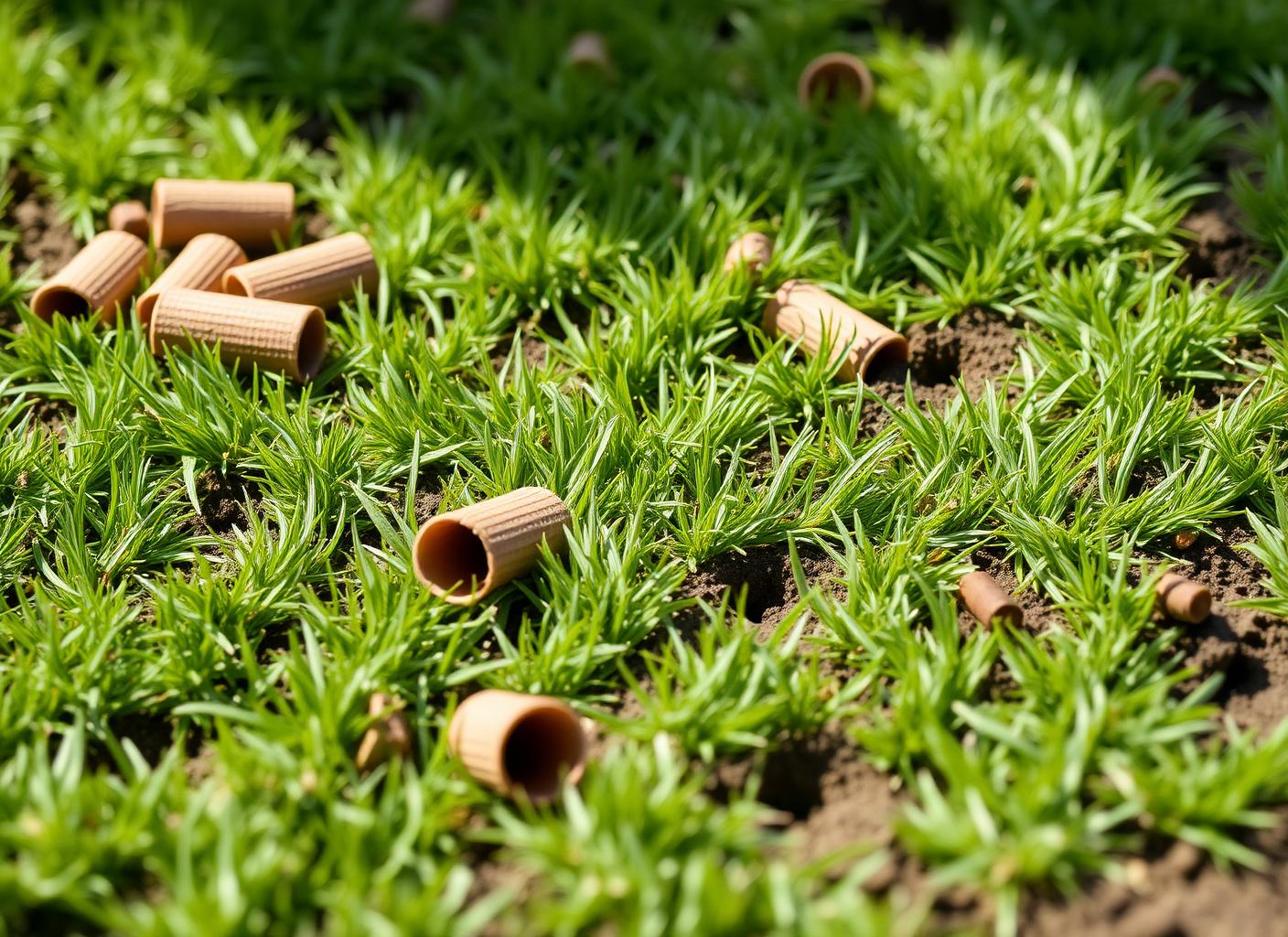
Core aeration removes small plugs of soil from the lawn, creating channels that can improve movement of air, water and nutrients into the root zone and relieve some compaction near the surface.
When should lawns be aerated in Pennsylvania?
For cool-season lawns, late summer into early fall is generally a favorable window, since turf is actively growing and can recover — and it lines up with the preferred period for overseeding.
Should I remove the soil cores afterward?
Cores are usually left on the surface to break down naturally over the following weeks, returning soil and organic matter to the lawn. Mowing and rainfall help disperse them.
Can compaction come back?
Yes. Traffic, mowing patterns, pets and normal use gradually re-compact soil, so many lawns benefit from aeration on a recurring basis rather than as a one-time correction.
Related Lawn Shield Services
Related Lawn Problem Guides
Turf guidance informed by Penn State Extension recommendations for Pennsylvania lawns. Penn State Extension does not endorse Lawn Shield.
Free Lawn Quote
Request Your Free Lancaster County Lawn Quote
Tell us about your lawn and we'll follow up with a program recommendation and pricing for your property. Programs start at $69 per application, based on a lawn up to 5,000 sq. ft.
- Free, no-obligation lawn quote
- Local Lancaster County lawn care team
- Program recommendation based on your lawn
Hard Soil, Struggling Lawn?
Open Up the Root Zone
Request a free evaluation and we'll check rooting, soil condition and wear patterns before recommending aeration or other steps.
Serving Lancaster County, Pennsylvania